KUBARK
| Edition | Original Art |
|---|---|
| Sujet | Narrative Art |
| Technique | Painting |
| Height | 200 cm |
| Width | 130 cm |
| Length/Depth | 6 cm |
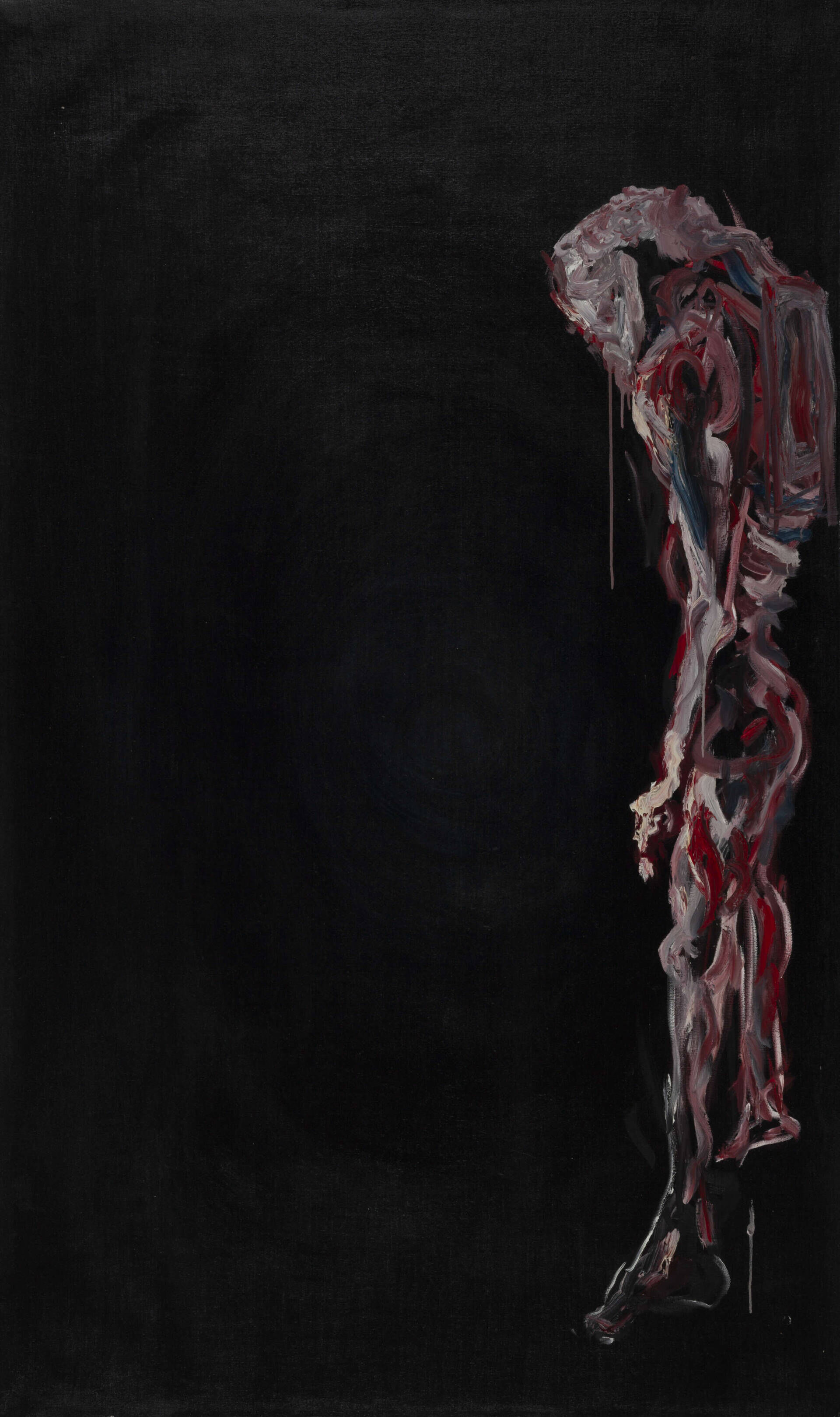
The work “KUBARK” was created during an intensive exploration of the subject of “white torture” or psychological torture. It was not created out of inspiration, but rather developed under the influence of this distressing subject matter. The title ‘KUBARK’ refers to a CIA manual designed as a guide for interrogators, containing detailed instructions on the use of psychological torture methods – a direct indication of the depth and gravity of the subject.
The painting was created in my flat, where, on an easel, it almost reached the ceiling. Originally, the canvas featured less impasto-laden, figurative compositions, which were gradually supplanted by an increasingly expressive and gestural style of painting as the process unfolded. This development reflected the emotional intensity and dynamism that characterise the work.
A decisive moment was the unexpected ‘intervention’ of a fly. It buzzed around the room and frequently came dangerously close to the painting whilst I patiently devoted myself to modelling the figure’s face. Just as the face – and thus the painting – was finished, the fly flew straight into the painted figure’s eye, leaving a disfiguring mark. To my regret, the fly could not be saved. Its demise and the marred eye led to frustration and a fit of rage, which resulted in a radical reworking of the face into its current form.
This event, as fortuitous as it is significant, adds another layer to the work. It underlines the unpredictability and the raw, emotional commitment that went into the creation of the painting. The texture of the painting and the expressive brushstrokes reflect not only the inner conflict, but also the destructive power of psychological influences, which form the central theme of the work.
The result is a work which, through both its genesis and its visual presence, represents an authentic expression of emotional and conceptual struggle.
KUBARK, 2020, 200 x 130 x 6 cm, oil on canvas
:
The work “KUBARK” was created during an intense engagement with the topic of “white torture” or psychological torture. It was not born out of inspiration but rather developed under the impact of this distressing subject. The title “KUBARK” refers to a CIA manual designed as a guide for interrogators, providing detailed instructions on the application of psychological torture methods—a direct reference to the depth and gravity of the theme.
The painting was created in my flat, where it stood on an easel that nearly reached the ceiling. Initially, the canvas featured less impasto and more figurative compositions, which were gradually replaced during the painting process by an increasingly expressive and gestural style. This evolution reflects the emotional intensity and dynamism that define the work.
A decisive moment was the unexpected ‘intervention’ of a fly. It buzzed around the room and frequently came dangerously close to the painting as I patiently worked on modelling the figure’s face. Just as the face—and therefore the painting—was completed, the fly landed directly in the painted figure’s eye, leaving a disfiguring mark. To my regret, the fly could not be saved. Its demise and the disfigured eye led to frustration and an outburst of anger, resulting in a radical reworking of the face into its current form.
This incident, as accidental as it was significant, adds another layer to the work. It underscores the unpredictability and raw emotional engagement that went into its creation. The texture of the painting and its expressive brushstrokes reflect not only the artist’s inner conflict but also the destructive power of psychological influences, which is the central theme of the piece.
The result is a work which, through both its genesis and visual presence, represents an authentic expression of emotional and conceptual confrontation.
KUBARK, 2020, 200 x 130 x 6 cm, oil on canvas
Michael Tauschke
Statement My works explore the spaces
between light and darkness,
the natural and the artificial,
life and transience.
Figures and flowers are imbued with metaphorical meaning.
The light source becomes a symbol
that lends the flower character, emotion and spirit.
And ‘respice finem’¹ is the motto of the figures in Outopos².
The technique is oil on canvas and
wood, applied in glazes as well as impasto, predominantly in large formats.
The content is immediately accessible
and stands up to even the most
radical³ scrutiny.
¹Latin: ‘Consider the end’
² Ancient Greek: οὐ – τόπος = nowhere
³
Latin
: radical = root (going right to the root). Where required, the paintings offer sufficient depth of content for serious engagement.
Career2024–27 Master’s student under Christian
Sery
Scholarships2024
Arras
ScholarshipExhibitions
2025
Kunsthalle im Lipsiusbau: WdBK
Dresden,
GermanyNEUE ArT
Art
Fair: Mix & Match
Dresden, Germany
University Art Biennial: Art Week 2025
, Mallorca, Spain
; SKM Gallery Leipzig: 5th SKM Community Exhibition
,
April 2025
,
Leipzig
, Germany
; Hole of Fame: Organic Exist
ences,
Dresden
,
Germany
; 20
24
: Künstlerhaus Loschwitz: AusChecken
(solo exhibition) Dresden,
Germany HfBK Dresden: Graduation Exhibition 2024 Dresden
, Germany
Dannenwalde Church: The Sacred and the Profane
Dannenwalde,
Germany Dresdner Sezession 89 e.V. / galerie drei: All My Love, Yours…
Dresden,
Germany 2023
Galerie Holger John: Bilderladen
Dresden,
Germany 2021
Urban ShiDD: Anger on Canvas
(solo exhibition) Dresden, Germany
2020 State Office
for Transport and Road Construction: Off
the WallDresden,
Germany2018
HfBK Dresden Senate Hall:
ExhibitionDresden,
Germany2017Dresden
Transport
Museum
: Group exhibition during the
orientation
phase
Dresden, Germany