

INSPIRATION

Cheers! The tradition of drinking in art history
Alcohol plays a significant role in many cultures. It features in rituals and religious ceremonies, is part of social gatherings, and marks special occasions such as social celebrations or business meetings. At the same time, drinking is not merely a matter of the occasion, but also of the significance attributed to it. The choice of a drink and its quality can signify social status, whilst intoxication is associated with a joyful loss of control and ecstasy, but also with decadence and transience. Alcohol consumption runs as a cultural constant through the history of Western art, taking on different meanings depending on the era and social context.


What sort of pictures are suitable for the kitchen?
Pictures in the kitchen transform a purely functional space into a place where you enjoy spending time. Unlike in the living room, the kitchen is subject to damp, grease vapours and limited wall space between cupboards and the tiled splashback, which is why the subject, size and material should be chosen with greater care than elsewhere in the home. This article shows you which wall art is suitable for the kitchen, how kitchen design and the choice of artwork complement each other, and why a hand-painted original often makes a greater impact than a mass-produced print.


The Female Body and the Gaze in Art History
The female body, often depicted nude, is one of the oldest motifs in art history. From mythological goddesses through the classical nude to contemporary painting, femininity is observed, staged, idealised and desired. However, images do not merely show; they also determine how we see. Who is looking? Who is being looked at? And who decides how a body is depicted?

The best online art galleries: a comparison of 10 platforms
Anyone wishing to buy art online now has far more options than they did a few years ago. The range on offer extends from specialised platforms for emerging artists to international marketplaces and traditional mail-order galleries. However, not every platform operates in the same way: some sell works directly from artists, whilst others work with galleries or art dealers. There are also significant differences when it comes to originals, editions, reproductions, advice and returns. In this comparison, we compare ten well-known providers. It is not just the size of the range that is decisive. We also look at where the works come from, how transparent their provenance is, what services buyers receive, and for whom each platform is particularly suitable.


A brief history of art: from cave dwellers to the modern era
The award-winning poet Octavio Paz once wrote that the first thing humankind did upon realising its own mortality was to build a grave. With this thought, human creativity begins right at the dawn of history: as a response to the finiteness of life and as a fundamental characteristic of our species. The history of art is thus far more than the history of beautiful images. It tells of humankind’s attempt to understand the world, to capture experiences and to give form to the invisible. From the first handprints on cave walls to the images generated by artificial intelligence in our present day, art has accompanied the development of humankind, changing just as constantly as our understanding of ourselves.

A summer dream blending art and literature
There are themes that recur time and again in art because they cannot be fully resolved: love, death, nature, longing. And then there is summer. For centuries, it has been painted, described, sung about and remembered. Sometimes as a time of abundance and freedom, sometimes as the high point of a cycle of life whose end is already foreshadowed by its very fullness.

What sort of art is best suited to the bedroom?
The bedroom is an intimate space where you want to feel at ease. You spend a lot of time here, during which you aren’t necessarily always consciously aware of your surroundings, but the atmosphere of the room is crucial. Art helps to create a calming atmosphere that makes you feel at ease. But what sort of art is best suited to the bedroom? Above all, art featuring calm, low-contrast motifs and muted, warm or cool shades such as blue, green, beige or terracotta – for example, abstract compositions, minimalist nature motifs or gentle colour-field paintings. More important than the exact motif is that the art complements the overall atmosphere of the room and is chosen in a size that blends harmoniously with the bed and the surrounding wall. A single, high-quality wall hanging above the bed usually has a calmer effect than many small, varied pictures.

Line, form and contrast – What is abstract art?
‘I could do that too.’ Have you ever found yourself thinking that at an exhibition? We often have this thought when looking at abstract art. Yet what may appear at first glance to be painted at random usually has a deeper meaning. What is abstract art? In short: an art movement that dispenses with the depiction of recognisable objects, people or landscapes and instead works with colour, form, line and composition. Rather than depicting a subject, an abstract work expresses moods, rhythms or inner processes – the meaning arises in the eye of the beholder.

From Homer to Hollywood – The Odyssey’s Journey Through Art History
The Odyssey, the epic traditionally attributed to the ancient Greek poet Homer, recounts the adventurous return of Odysseus, which, following the Trojan War, is to lead him back to Ithaca through the world of myth over the course of many years. In more than 12,000 verses, the poem describes his wanderings, encounters with gods and monsters, as well as his longing for home and his attempt to find his way back to his own life after the war.

Buying Art, or: How to Help Shape Art History
Every art collection begins with the acquisition of a single work. Although art is relatively rarely regarded as a traditional form of investment, over the centuries works of art have proved to be far more than mere decorative objects. They are cultural assets, tangible assets and, not infrequently, investments whose value can appreciate over time. Unlike shares or property, however, art offers not only a form of wealth that can be experienced directly, but also the opportunity to help shape cultural developments.

What is an art print – and how does it differ from the original?
Anyone buying art for the first time will soon come across terms that sound similar – but mean completely different things: art print, original, reproduction, giclée. What exactly is what? We’ll explain it all here.

Bilder für das Wohnzimmer: So findest du das perfekte Kunstwerk
Ein Bild verändert einen Raum. Nicht nur optisch – sondern in dem, was er einem bedeutet. Dieser Ratgeber hilft dir, das richtige Kunstwerk für dein Wohnzimmer zu finden: ehrlich, praktisch und mit echter Leidenschaft für Kunst.

How much does an original painting cost? – Painting prices explained
There is no single, definitive answer to this question. The price range for original works of art extends from a few hundred euros to sums running into millions or even billions. Painting prices are determined by various factors: the artist’s reputation and market standing, the quality and craftsmanship of the work, its rarity, and whether the artist is still alive or already established in art history – put simply: demand on the art market. An original work by an up-and-coming, as yet little-known artist can therefore hardly be compared with a work by Pablo Picasso.

Which works of art are popular at the moment?
By 2026, it will be clear that the question of which works of art are popular can no longer be answered solely on the basis of names or periods, but rather in terms of their impact and relevance. What is in demand is art that moves people, tells a story and, at its best, creates a personal connection. Current favourites reflect precisely the major art trends of 2026 – from emotional depth and tangible materiality to exciting colour palettes that balance earthiness with digital intensity.

Understanding art prizes – the ‘artist factor’ explained
If you’ve ever stood in front of a work of art and asked yourself, “How is the price of art determined?”, you’re not alone. For buyers in particular, pricing often seems hard to grasp. Unlike with property, for example, or in many other sectors, there is no ‘art price index’. Instead, there is another concept that provides greater clarity: the artist factor.
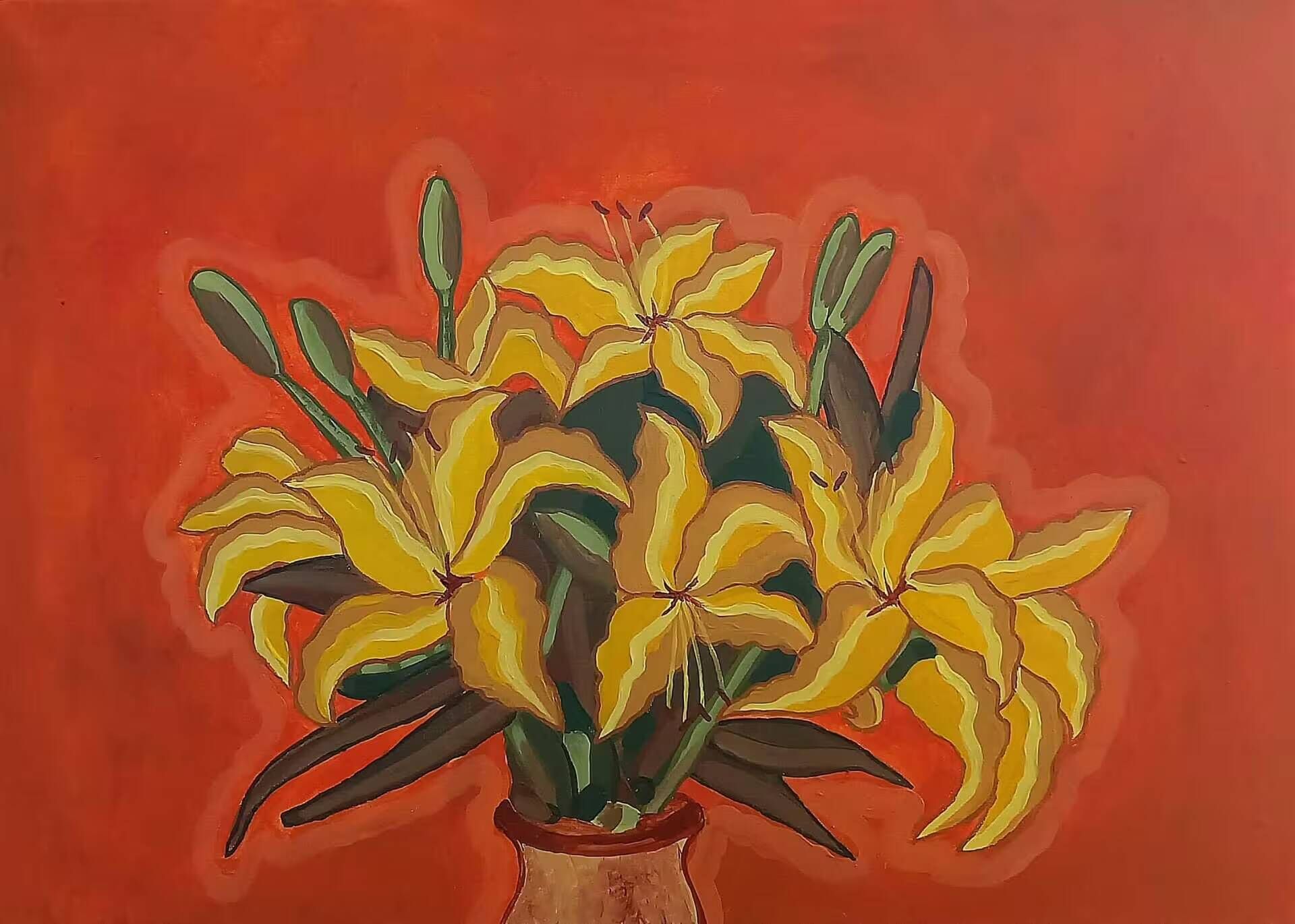
Flower paintings – timeless works of art brimming with life
Flowers are more than just pretty splashes of colour in a vase. They are symbols of beauty, transience and sensuality – and they have been inspiring artists for centuries. No wonder, then, that flower paintings are among the most popular subjects in art history. Whether it’s Monet in a French garden, Van Gogh with his famous sunflowers or Georgia O’Keeffe with her intense close-ups: flower paintings tell stories, capture emotions and bring a piece of nature to the canvas.