HAL
| Edition | Original Art |
|---|---|
| Sujet | Abstract |
| Technique | Painting – Acrylic on Canvas |
| Height | 200 cm |
| Width | 160 cm |
| Length/Depth | 3.5 cm |
Oil and ink on canvas, mounted on an aluminium stretcher frame
Painted with a brush. In the initial stage, the canvas is stretched onto a wooden stretcher to ensure the necessary counter-pressure during the painting process, which is required for working with fine adhesive edges and colour gradients. The work is later re-stretched onto a high-quality aluminium frame to simplify handling and hanging.
The underlying approach behind the painting ‘:’
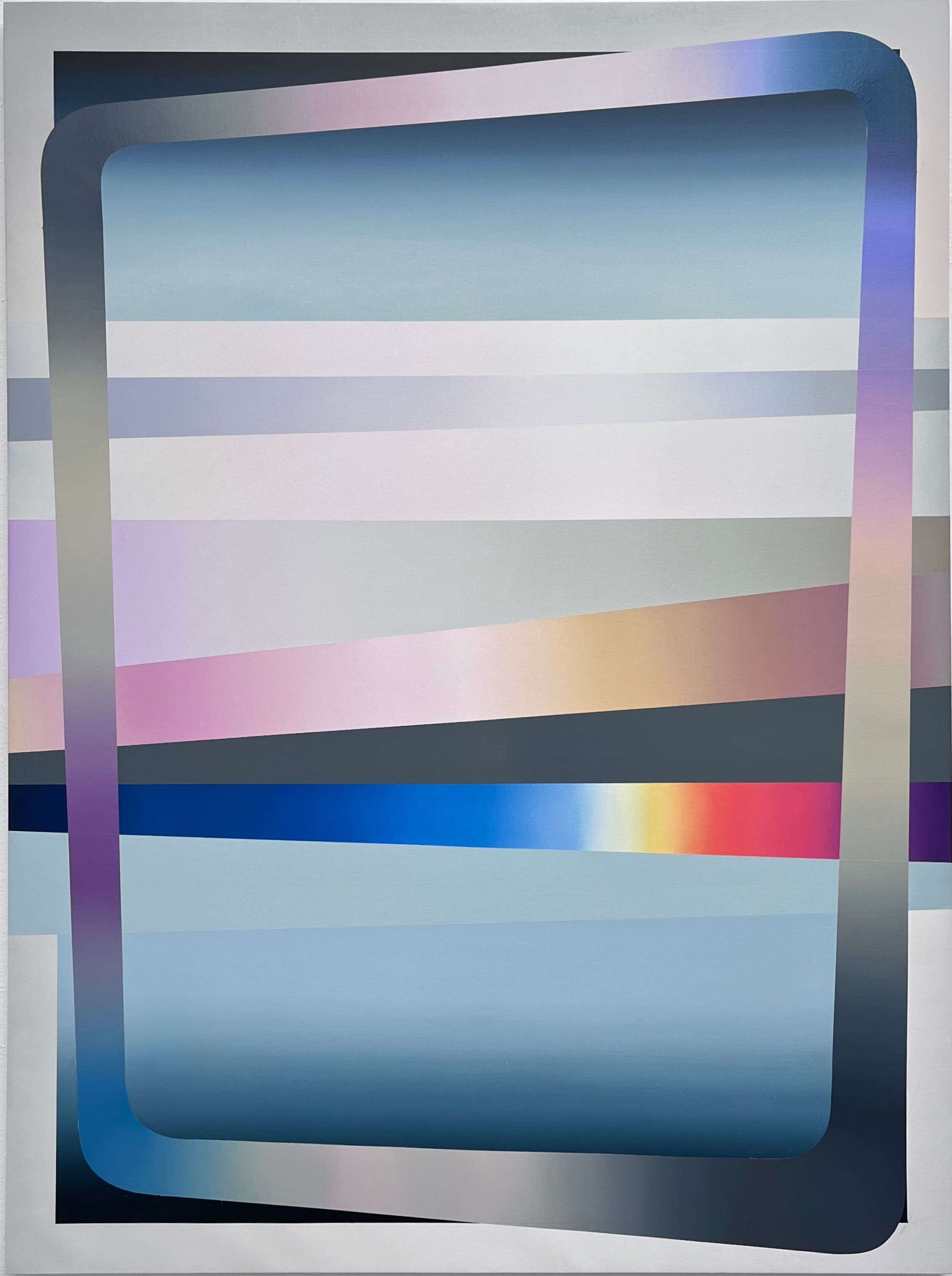
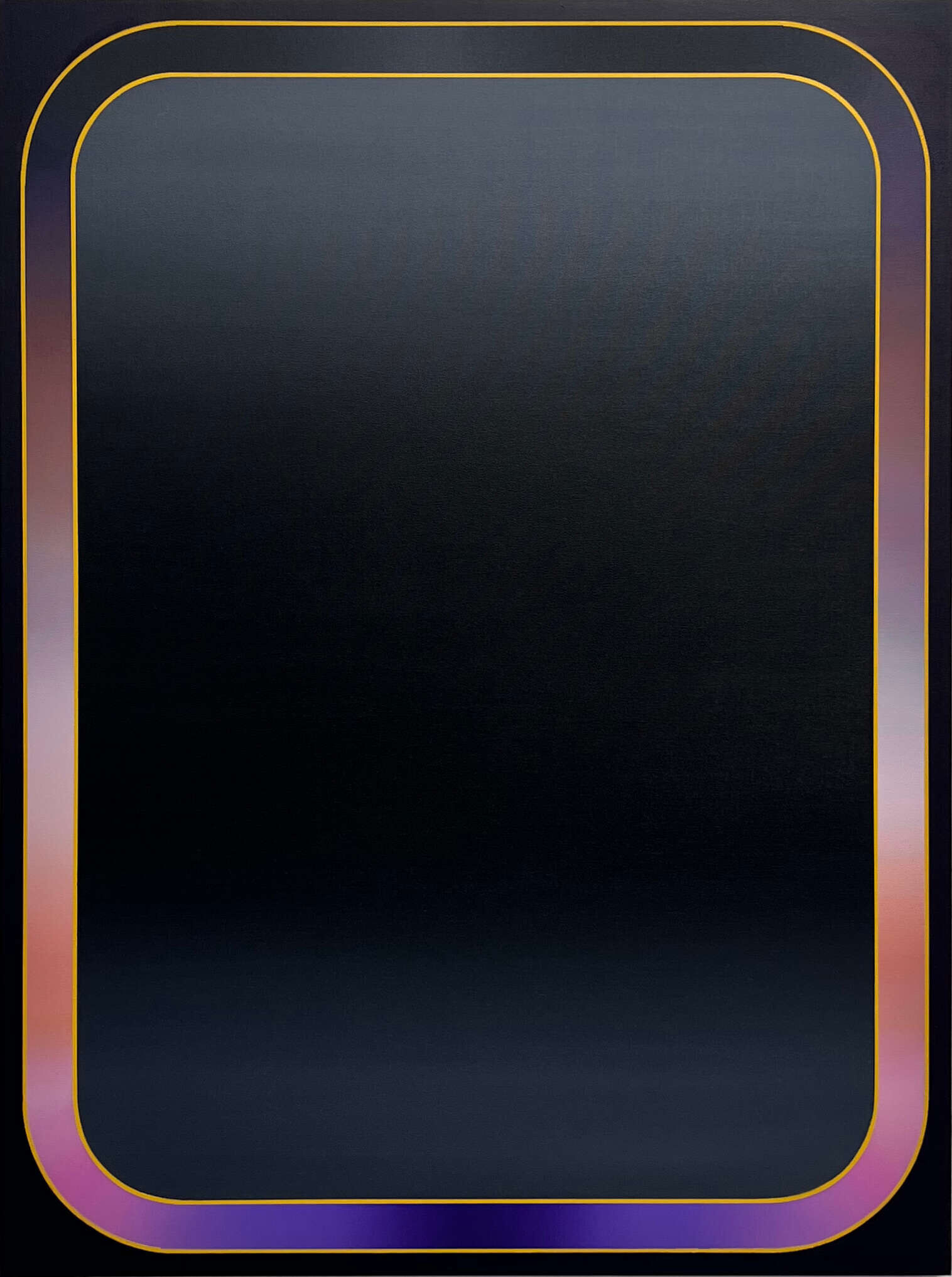
‘HAL’ is a work from the ‘Tuning’ series, which I have been developing since 2018 and in which a continuous, gradual process of de-representation takes place, initially removing all formally distinctive elements from the pictorial space. It is about painting. About painting, colours and light for their own sake. Whilst I originally came from a very formal, raw, representational and even narrative way of working – one that practically shouted out its messages in an almost adolescent manner and, at the same time, contained a great deal of chance – I now strive, through extensive reduction in colour and form, towards an absolute, elementary aesthetic experience which, in the rigour of its clear forms and colours, excludes chance – at least seemingly.
On the one hand, the arrangement of colour and form is about creating a technoid, precise impression. A work that, viewed from a certain distance, can appear almost digitally installed in the space, whilst up close it in no way denies its artisanal origins as a painting created with brush and oil paint.
In HAL, however, a basic composition of black, gradient-like ink is added, which, through its matt, almost graphite-like surface, makes the oil colours appear even more strikingly contrasting.
The creative process involves various iterative steps and elements of chance. If the initial idea is one of a rough ‘colour sound’, I also deliberately employ intuitive or spontaneous colour compositions by combining, in my studio – which, during the working process, consists of a sometimes very great chaos surrounding the picture, in contrast to the artwork itself — from countless paint boxes and palettes whilst the paints are still in a workable state. In this way, I create questions on the canvas during the painting process, which I then combine with carefully selected areas of colour and colour gradients.
This often requires further, diverse and deliberate modifications until a work finally meets my expectations.
But why all this?
Ultimately, every painting is the current culmination of a long process of development. In some way, every painting embodies the journey that led to it, the 30 years of painting that preceded it, as well as my self-awareness – in the sense of being conscious of myself, as an artist, as a human being, within the context of my artistic contemporaries and the world at large. For me, painting a finely elaborated colour gradient holds a contemplative element that gives me a strange sense of calm; I can repeat this process for hours and days on end, granting my mind a temporary escape from the fast-paced (digital) stream of images and events that surrounds me every day.
In doing so, I filter the final colour combinations not only through the aforementioned element of chance – ‘paints that haven’t yet dried in chaotic arrangements within paint boxes’ – but also from my everyday observations and the themes that preoccupy me.
Digital colour selection scales, two-tone paint finishes on tuned sports cars, sunsets, heavy industry, space and reflections in coffee can all find their way into the colour compositions.
One could certainly describe my approach to painting as a romantic one cloaked in logic. The indirect experience and perception of the forces of nature are reduced to colour gradients reminiscent of natural phenomena, yet which already bear the mark of human influence. Colours that evoke chemical transformation processes. Sunsets that may contain smoke, fire and toxicity in the atmosphere, yet in their visual world are, at first glance, simply ‘just beautiful’.
As is often the case in my work, the title was inspired by pop-cultural influences. Here: ‘HAL 9000’, the neurotic computer in Stanley Kubrick’s 2001: A Space Odyssey,
translating the science fiction and technoid aesthetic into a counterpart in the large-format painting. But beware – the choice of title can always set the tone for interpretation whilst simultaneously leading one astray.
Shipping:
The work will be shipped stretched on an aluminium stretcher frame – including a certificate of authenticity and a signature on the reverse.
The work is currently on display at the SKM Gallery and cannot be dispatched until mid-November. If you require earlier delivery, please contact the SKM team.
Daniel Wöllenstein
Lives and works in Cologne.
Artistic career
Education
2002–2009 Studied art at the University of Cologne under Rainer Barzen and Silke Leverkühne
Since 2007: Studio at KunstWerk Cologne
Exhibitions (selection)
2007 Blaumachen, KunstWerk Cologne
2008 ‘Bogen 2: Straight from the HART’ –
2008 Long Night of the Museums – ‘Festive Processions and Diodramas’
2008–2009 ‘Darwin – Design and Creation of a KVB Tram’ to mark Darwin Year 2009, in collaboration with students from the University of Cologne
2011 “Fette Nager – Bello and I” – Museum Night – KunstWerk Cologne
2016 nxnw Festival collaboration with Slobodan Kajkut “20 Interventions”
2016 “Raum 500” – exhibition with Olga Jakob and Heike Simmer – nxnw Festival
2017 “HORST” – KunstWerk Köln
2014–2017 Board member at KunstWerk Köln e.V.
2017 Chairperson of KunstWerk Köln e.V.
2019 Long Night of Museums “Wedding” – installation and collaboration with Heike Simmer
2021 TUNING – KunstWerk
2025 afternoonprojekts with Tom Gully, Oskar Lovis and Gilbert Flöck – KunstWerk Cologne
2026 Fragmented Realities – vonfraunberg Art Gallery, Düsseldorf
2026 Artist of the Month at SKM
Upcoming
June SKM Pop-up Exhibition, Munich
August: SKM Community Exhibition, Leipzig
Artist Statement
What’s it about? The works are taken from the ‘TUNING’ series – spanning the period from 2018 to the present day, although the pure colour segments have only come to dominate the ‘TUNING’ series since 2021. The focus is on a gradual abstraction and reduction of the pictorial content, whilst references to natural and man-made phenomena can be found in the colour and form compositions.
Within the seemingly equal segments, compositions of colour and form can create foregrounds and backgrounds that shift fluidly depending on the viewer’s focus. The play of light, which can be intensified by contrasting colour gradients to the point of ‘glow’, contributes to the sometimes sculptural impact of the works.
Digital colour selection scales, flip-flop paint finishes from tuned sports cars, sunsets, heavy industry, space and reflections in coffee can all find their way into the colour compositions.