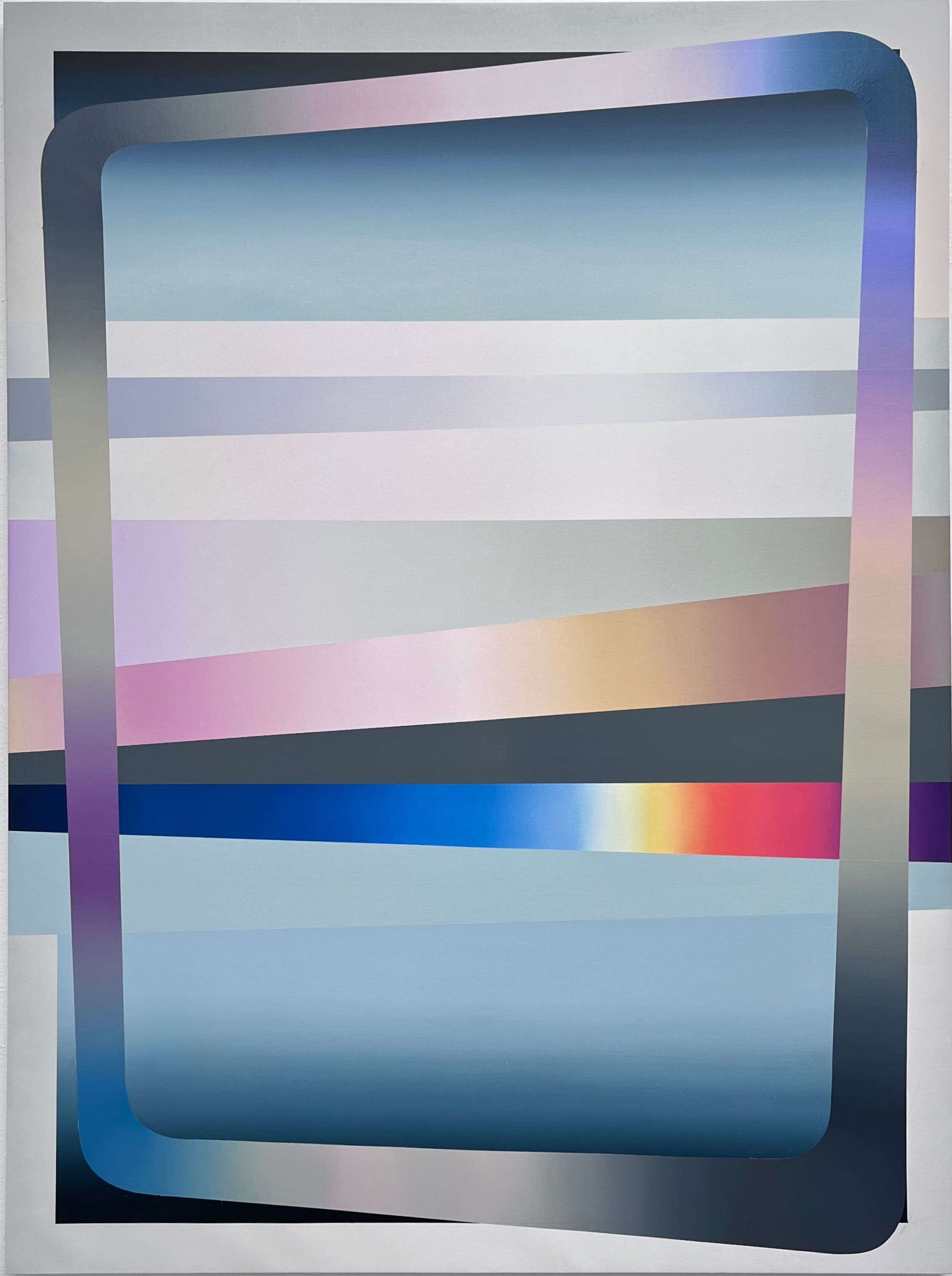
REDOX OX
| Edition | Original Art |
|---|---|
| Sujet | Abstract |
| Technique | Painting |
| Height | 160 cm |
| Width | 120 cm |
| Length/Depth | 3.5 cm |
Medium:
Oil on canvas stretched over a wooden frame with a plywood panel glued to it
Technique:
Painting with a brush
Shipping:
The work is shipped stretched onto a wooden frame with a glued-on plywood panel – including a certificate of authenticity and signature on the reverse.
This means the canvas is stretched over the plywood panel beneath it. Consequently, the work is heavier and more stable than standard stretcher frames.
REDOX OX draws on a colour scheme inspired by chemical metallic transformation processes; the colour gradients placed side by side sometimes reinforce each other, whilst at other times they contrast in colour. The edges and clean curves of the colour gradient frame are executed with great precision, thereby contrasting with the colour-coordinated yet open-plan background.
This minimalist approach allows space to focus specifically on the individual aspects of the image. The work comes to life through a combination of precision, presence and restraint.
My current aim in my work is to achieve the greatest possible degree of abstraction.
Here is a text that forms the basis for my current series.
Abstraction
Perhaps there is no object in which its de-objectification is not inscribed. Not necessarily as dissolution or final fragmentation, but as a withdrawal from the objectifying gaze. For the object, which in Ancient Greek is called Α ν τ ι κ ε ί με ν (Latin: objectum), marks the counterpart of a (perceiving) subject, which we call the object. It stands opposite, forms an opposition and, in doing so, is constituted not only within the subject-object relation; it also proves to be a construct which, like any construction, can be broken down into its constituent parts. This decomposition is inherent within it. Rather than being an act imposed from without, it is a priori inherent in the object’s concreteness. In fact, seeing does not mean exclusively synthesising or assembling in order to constitute concreteness. Seeing equally means analysing, decomposing, splitting and fragmenting. The whole is invisible. Only the decomposing gaze, whose power of separation is tireless, gains concreteness. To do so, it must be sensitive to the fissures that hold the elements of the object together in their difference from one another. This sensitivity also extends to the contingent nature of the composition of the concrete world. Often, the connections between its elements could be different from what they are. Indeed, the concept of de-objectification points to the principle of contingency. Things are as they are, yet they need not be so. Contingency expresses the instability or arbitrariness of the world. It is an ontological indicator of the fragility of the world of things, that is to say, also of its transformability. De-objectification also means: the de-realisation of the real in favour of a reality as yet unknown.
Marcus Steinweg
Daniel Wöllenstein
Lives and works in Cologne.
Artistic career
Education
2002–2009 Studied art at the University of Cologne under Rainer Barzen and Silke Leverkühne
Since 2007: Studio at KunstWerk Cologne
Exhibitions (selection)
2007 Blaumachen, KunstWerk Cologne
2008 ‘Bogen 2: Straight from the HART’ –
2008 Long Night of the Museums – ‘Festive Processions and Diodramas’
2008–2009 ‘Darwin – Design and Creation of a KVB Tram’ to mark Darwin Year 2009, in collaboration with students from the University of Cologne
2011 “Fette Nager – Bello and I” – Museum Night – KunstWerk Cologne
2016 nxnw Festival collaboration with Slobodan Kajkut “20 Interventions”
2016 “Raum 500” – exhibition with Olga Jakob and Heike Simmer – nxnw Festival
2017 “HORST” – KunstWerk Köln
2014–2017 Board member at KunstWerk Köln e.V.
2017 Chairperson of KunstWerk Köln e.V.
2019 Long Night of Museums “Wedding” – installation and collaboration with Heike Simmer
2021 TUNING – KunstWerk
2025 afternoonprojekts with Tom Gully, Oskar Lovis and Gilbert Flöck – KunstWerk Cologne
2026 Fragmented Realities – vonfraunberg Art Gallery, Düsseldorf
2026 Artist of the Month at SKM
Upcoming
June SKM Pop-up Exhibition, Munich
August: SKM Community Exhibition, Leipzig
Artist Statement
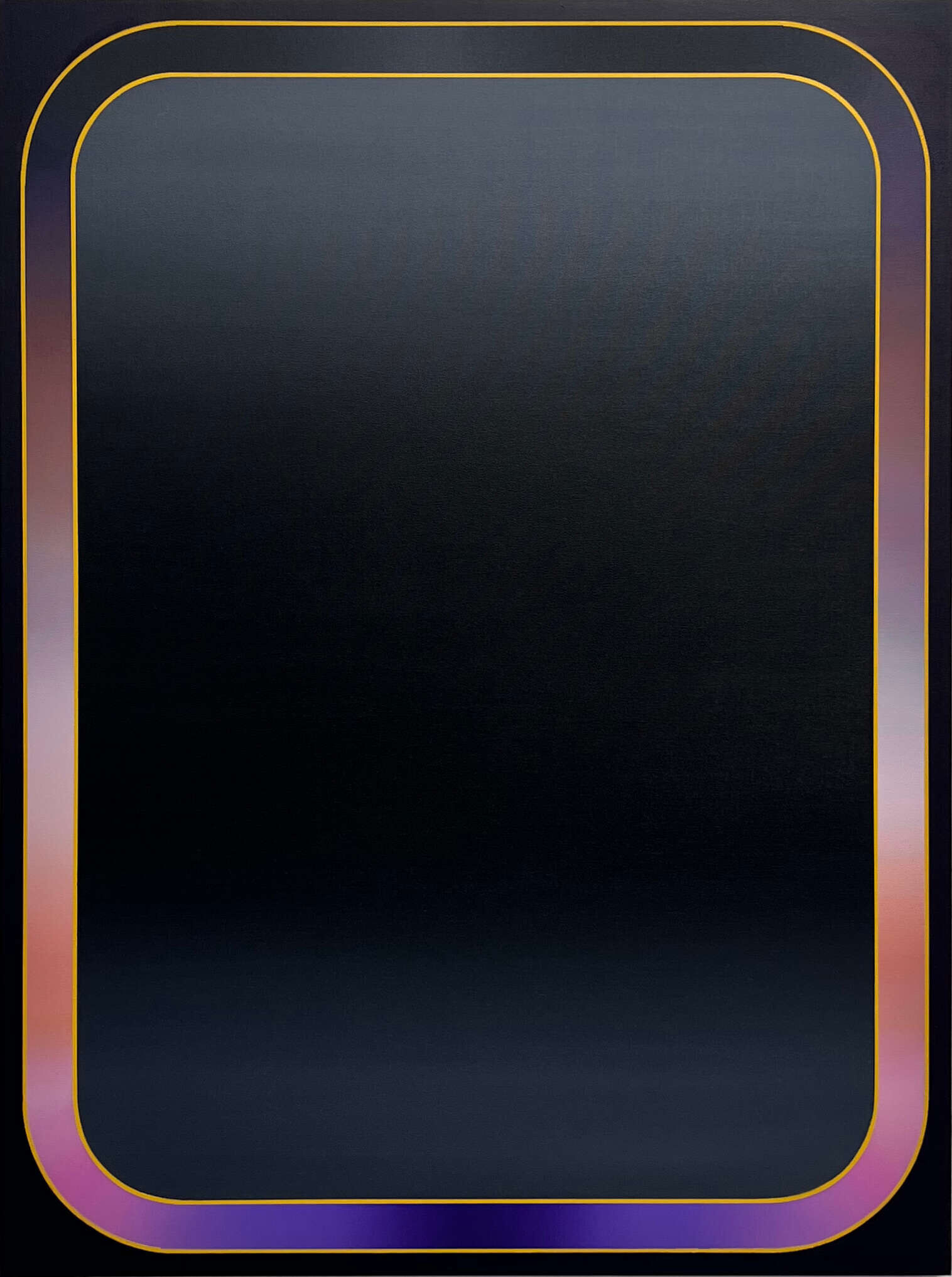
What’s it about? The works are taken from the ‘TUNING’ series – spanning the period from 2018 to the present day, although the pure colour segments have only come to dominate the ‘TUNING’ series since 2021. The focus is on a gradual abstraction and reduction of the pictorial content, whilst references to natural and man-made phenomena can be found in the colour and form compositions.
Within the seemingly equal segments, compositions of colour and form can create foregrounds and backgrounds that shift fluidly depending on the viewer’s focus. The play of light, which can be intensified by contrasting colour gradients to the point of ‘glow’, contributes to the sometimes sculptural impact of the works.
Digital colour selection scales, flip-flop paint finishes from tuned sports cars, sunsets, heavy industry, space and reflections in coffee can all find their way into the colour compositions.