


by Evelina
Status: 10.03.2026
Cheers! The tradition of drinking in art history
Key points at a glance
- Alcohol is a cultural constant and has played a role in rituals, festivals, social gatherings and special occasions since ancient times.
- In antiquity, wine was central to social life, for example at Greek symposia and festivals in honour of Dionysus. The Romans also adopted this drinking culture.
- The Christian Middle Ages: wine took on religious significance as a symbol of the Blood of Christ and became part of the Eucharist. At the same time, beer gained in importance as an everyday drink.
- In early modern Dutch painting, drinking and tavern scenes became popular motifs. They depicted everyday life and conviviality, but often served as moral warnings against excessive consumption.
- With the advent of the modern era, the focus shifted more towards the individual experience of intoxication. Alcohol became associated with conviviality, freedom and a breaking down of boundaries, but also with loneliness, decadence and social problems.
- Contemporary art continues to explore these diverse meanings: from community and pleasure to loss of control, addiction and social critique.

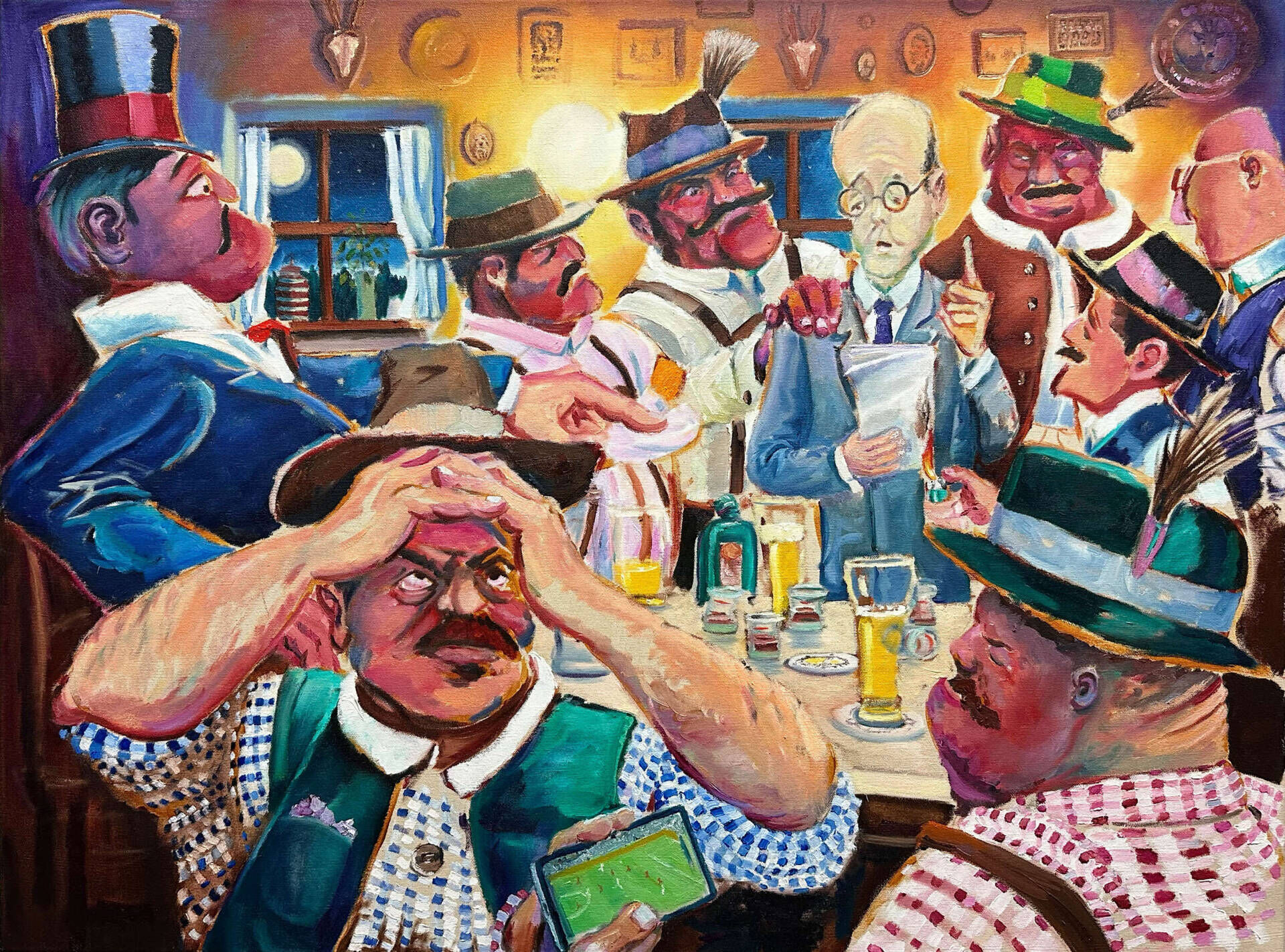
Alcohol plays a significant role in many cultures. It features in rituals and religious ceremonies, is part of social gatherings, and marks special occasions such as social celebrations or business meetings. At the same time, drinking is not merely a matter of the occasion, but also of the significance attributed to it. The choice of a drink and its quality can signify social status, whilst intoxication is associated with a joyful loss of control and ecstasy, but also with decadence and transience. Alcohol consumption runs as a cultural constant through the history of Western art, taking on different meanings depending on the era and social context.




Wine in Antiquity and the Christian Middle Ages
As early as in ancient Greece, wine played a central role in social and cultural life. It was a feature of symposia and public festivals and was even celebrated in its own right during festivities honouring Dionysus, the god of wine and ecstasy. When people drank together, they not only celebrated, but also engaged in discussion, recited poetry and made music. Surviving drinking vessels such as the kylikes bear witness to this to this day and have turned the culture of drinking itself into a visual motif.
This tradition was also adopted by the Romans and incorporated into their own culture. The associated festivals and deities found new counterparts in Bacchus and the Saturnalia. Particularly in mosaics and murals, alongside scenes of drinking, grapes and vines are frequently found as decorative elements of an established visual language.
With the advent of Christianity, wine became a symbol of the blood of Christ and an integral part of the Eucharist. At the same time, the focus of Western art history shifted increasingly towards Central and Western Europe, bringing regional drinking customs more to the fore. Beer, known since antiquity, thus also found its way into medieval visual culture.


Drinking culture in early modern Europe
This development is particularly evident in 16th- and 17th-century Dutch painting. People drinking, tavern scenes and convivial gatherings became popular motifs in genre painting. In the process, drinking was detached from its religious or mythological context, anchored in everyday life and, at the same time, became the starting point for moral and social commentary.
A particularly well-known example is Jan Steen’s ‘As the Old Sang, So the Young Chirp’, dating from around 1668 to 1670. The boisterous family scene depicts adults and children eating, drinking and making music. What at first appears to be a cheerful everyday scene also contains a clear moral warning: the children are adopting the behaviour of the adults and, with it, their vices.
The Thrill of Modernity
This critical view of drinking persists in the modern era, whilst at the same time the individual experience comes more to the fore. Intoxication, conviviality, loneliness and the blurring of boundaries are now increasingly depicted as subjective states. Whilst artists such as Max Beckmann and Otto Dix portray the decadence and social tensions of modern city life, others focus on the individual experience of intoxication and isolation. To this day, the portrayal of alcohol consumption oscillates between conviviality and criticism: it appears both as a feature of social gatherings and as an expression of dependency and social issues.
From a religious symbol, through a social ritual, to an expression of intoxication, decadence and personal experience, drinking remains a constant in our culture. The following works from the gallery demonstrate the diverse ways in which these facets are expressed in contemporary art.

Alina Fenn - Rabbit and Vermouth
This work playfully bridges the gap between childhood and adulthood. The hare symbolises innocence, vulnerability and early memories, whilst the Martini bottle represents conscious, adult life. This juxtaposition creates a quiet dialogue between naivety and experience, light-heartedness and responsibility. The acrylic paints emphasise the clear visual language and the emotional tension between the two worlds.

Lou Stark - girldinner
Lou Stark’s figurative painting explores intimacy, friendship and those small moments of shared escapism. Building on her early work on depression, isolation and the desire to escape reality for a moment, she is increasingly turning her attention to female friendships. Alcohol, long nights and shared outings become moments of letting go – but also an expression of a special kind of connection.

Adrian Ferdinand - Bar
Adrian Ferdinand’s photographic work is characterised by a precise observation of the everyday and the incidental. His subjects are drawn from urban spaces, social life, subculture and fashion – always with a profound interest in values and questions of identity. With a keen eye for chance arrangements and fleeting moments, he captures situations that are often overlooked, yet reveal a distinctive aesthetic or abstraction.

Frequently Asked Questions
Studierenden Kunstmarkt is the leading platform for student art in the German-speaking world. It enables art enthusiasts and art lovers to buy artworks directly from art students, thereby providing them with financial support whilst they are studying.
Studierenden Kunstmarkt was founded in 2020 by Erich Reich and his brother. Erich is still the managing director of Studierenden Kunstmarkt and, together with his team, has succeeded in creating a platform that brings together art lovers, those interested in art and art students. To this day, Studierenden Kunstmarkt is entirely self-funded and has not received any external funding from investors.
At any given time, there are several hundred art students and several thousand works of art on the Student Art Market. A good place to start if you’re looking for an initial overview of the artists is the ‘Artists of the Month’ section.
Just like normal galleries, Studierenden Kunstmarkt receives a commission on each artwork sold. This funds the running of the platform, its maintenance and the salaries of Studierenden Kunstmarkt’s staff. In addition, we support the students, are on hand to advise on any queries, and run free advertising for them on Instagram, Facebook, Google and in our email newsletter, which has several thousand art lovers as subscribers.
There are many ways you can start investing in young artists on the student art market. One option is to sign up for our free email course, ‘Become an Art Expert in 7 Days’. In it, we’ll share a few basics with you, as well as some of our insider tips on which artists have particular potential. Find out more
Take a look at our most popular artists at the Student Art Market


News banner


